If you're reading this, chances are you're either preparing for the exam or wondering whether it's worth it. I’ll share my experience – and a few tips I wish I’d known before starting.
Before deciding to pursue the CFA Institute’s Certificate in Sustainable Investing (SIC), also referred to as the Certificate in ESG Investing until 2024, I scoured the internet – only to find surprisingly little first-hand feedback from actual candidates. There were plenty of posts referencing the SIC, but few offered concrete reflections...
Considering the CFA Institute has long been a major force in the finance industry – and CFA Charterholders are widely respected – I expected more.
After speaking with several finance, investment, and sustainability professionals who had completed what’s often called the gold standard in sustainable investing, I sat down to reflect: Does it really make sense to invest the time and money to pursue the SIC – especially after already completing programs like:
I decided to order the printed curriculum and dive into the CFA Institute’s take on Sustainable Investing.
Before I knew it, I had worked through all 560+ pages – and I thought, "not bad". I actually picked up a few things I wouldn’t have come across otherwise: from comparative governance structures across countries, to stewardship approaches, to how ESG factors influence valuation models like DCFs.
Earlier this year, I became a member of the CFA Society. Out of respect for the quality and mission of the CFA Institute, I decided to go all in, pay my dues, and register for the exam.
KEY FACTS
You can find the overview information on the offical CFA website here: Sustainable Investing Certificate | CFA Institute.
And the current printed curriculum here on Amazon.
Given its breadth, the SIC is ideal for anyone interested in the intersection of sustainability and investment. The curriculum introduces many key frameworks widely recognized in the sustainability space — such as the 6 Principles for Responsible Investment (PRI), the Taskforce on Nature-related Financial Disclosures (TNFD), and the 9 Planetary Boundaries (which, by the way, you should definitely know for the exam).
Compared to other certifications, the CFA SIC tilts more heavily toward the economic and financial perspective, anchoring sustainability in a clear investment context. This stands in contrast to programs, i.e. like the University of Cambridge’s CISL Sustainable Finance Programme, which take a more academic or conceptual approach.
So who will benefit most from this program?
No prior experience in ESG or finance is strictly required — but it helps. Having some background will definitely make the learning curve smoother and reduce your overall study time. Just keep that in mind when planning.
HOW TO PREPARE FOR THE EXAM
After payment, I received a confirmation email — and within a day, access to the online learning platform. From there, you have two options:
→ Use the interactive online platform,
→ or study from the printed curriculum (available separately).
I personally chose the printed book, which suited my learning style better — allowing me to annotate, highlight, and use post-its. The good news: There are no mandatory videos or progress gates to click through. You're free to learn at your own pace and in the format that works best for you.
Pro tip: I recommend reading the full book at least once and reviewing key chapters (e.g. ESG analysis, governance, stewardship, ESG valuation, integration). If you’re new to ESG or sustainable investing, be prepared to spend more time familiarizing yourself with key terms and concepts early on.
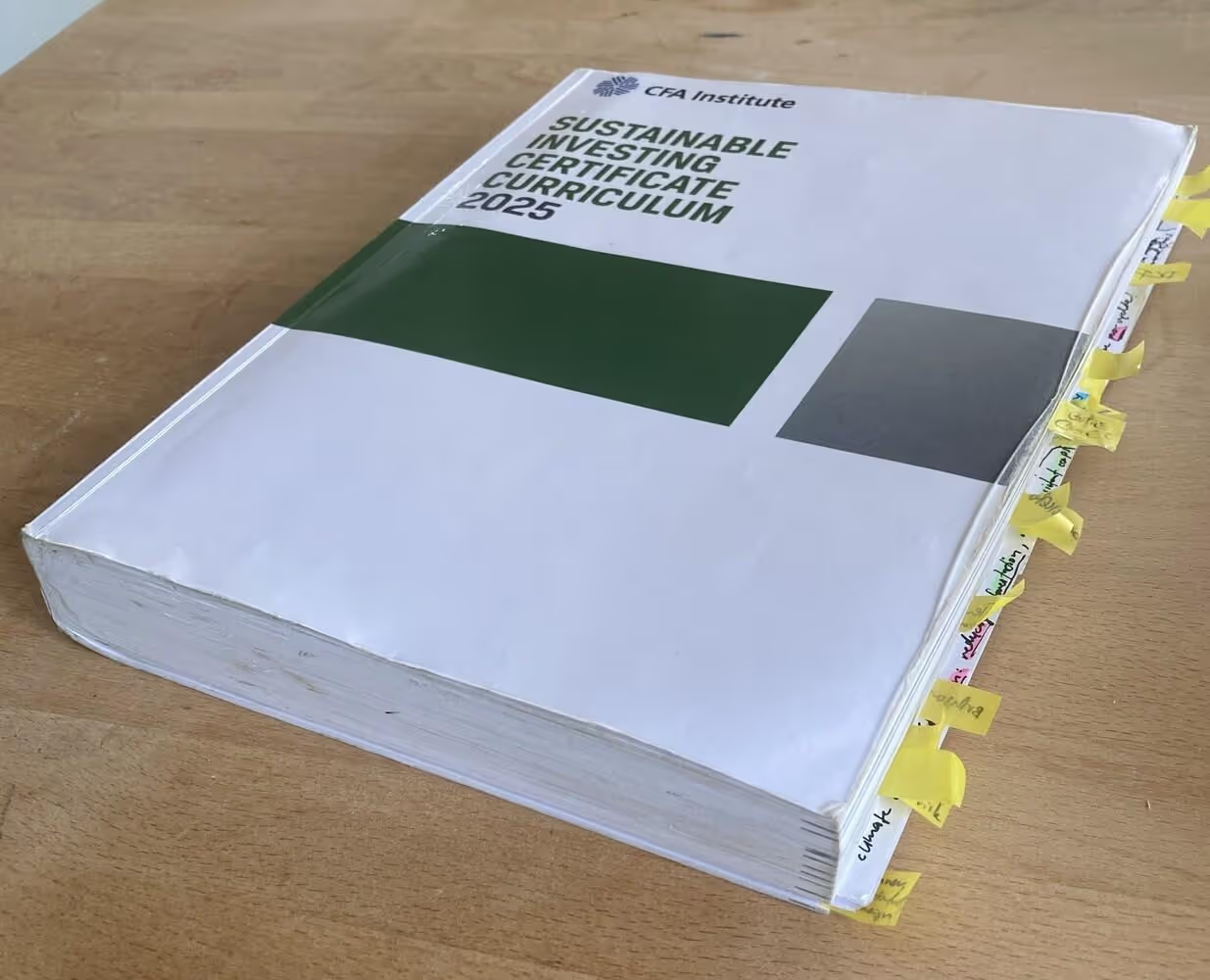
The Curriculum (as you can see, I used it quite a bit)
The curriculum consists of 9 chapters:
In the print version at the end of each chapter, you'll find practice problems with full solutions. They’re an excellent resource — not just for testing your knowledge but also for understanding the kind of questions CFA might ask. I highly recommend reviewing the surrounding content in the curriculum when going through the solutions. The volume of content per chapter is also a useful indicator of the likely exam weighting.
You also get access to quizzes and two mock exams via the CFA online platform. These are close to the real exam format — often slightly paraphrased, reordered, or reworded.
Each chapter is tested. Don’t skip anything. That said, the case studies appear not to be part of the exam (at least in my version).
There’s no need for external courses or materials — unless you want additional mock exams. Personally, I didn’t use any third-party resources and still felt well-prepared.
Pro tip: Once you’re done with the content, spend enough time practicing. The curriculum is more extensive than the number of possible test questions. Try to think laterally:
→ What other frameworks are related?
→ What would this question look like if reworded or asked in reverse?
During the actual exam, take your time. Read carefully — it’s easy to miss key qualifiers like “not” or “most/least likely,” and that can cost you points unnecessarily.
IMPORTANT INFORMATION BEFORE, DURING AND AFTER THE EXAM
SScheduling the exam was refreshingly simple and quite flexible — I was able to book a slot within a week of feeling ready. There are two options:
I went with the online option, which might be quicker depending on the season (I sat mine in August — perhaps less demand?).
A word of warning: if you choose OPT, you’ll need to download a lovely little piece of privacy-invading software called ProProctor. Use Google Chrome to download and access the platform. I downloaded it via Firefox, did the systems check — all green — only to find out on exam day that nothing worked. I had to uninstall everything and start from scratch with Chrome. Not ideal, but the good news: your exam time doesn’t start until you're in. Your experience may vary.
Before you even see your first question, you'll go through a 15-minute room inspection with a live proctor. Yes, they will ask you to show your walls, the back of your monitor, and even the pockets of your trousers. After that, you're handed over to another proctor who monitors you live as you take the exam — camera on at all times, of course.
You’ll see your result immediately after submitting your answers. If you passed, expect a follow-up email granting access to your digital certificate and badge.
That said — don’t expect a physical certificate or a glossy PDF. The design is functional at best (not quite up to the level - looking at you HBSO or UNPRI).
Also: unlike the mock exams, you won’t receive a breakdown of your performance. No info on what you got right or wrong — just a yes or no.
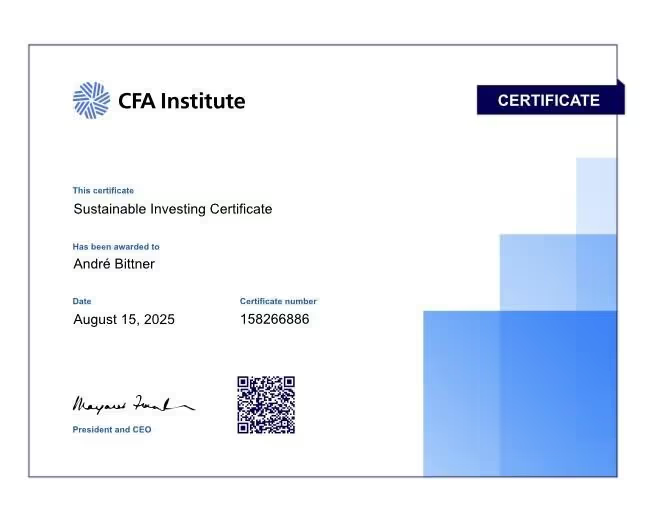
The digital Certificate
IF YOU WANT TO PASS THE EXAM
…and earn the CFA SIC credential (depending on your pre-knowledge), here’s how I recommend preparing:
From my experience, chapters 5 to 8 deserve particular attention (but keep in mind: all content is testable — so don’t skip).
Still unsure? You can purchase additional mock exams from external providers — not a must, but helpful if you want more practice.
PRO TIPS
Know your frameworks: PRI Principles, TCFD, TNFD, ICMA Principles, SASB, UK Stewardship Code, CICERO, EU Taxonomy, EUDR, Equator Principles, Helsinki Principles, etc. Not in detail, but at least the core contents!
Understand key ESG concepts:
There’s a lot to cover — but once you see the connections, it starts making sense. And remember: success is less about memorizing facts and more about understanding relationships and implications.
THINGS I DIDN'T LIKE
Was it worth it you might ask?
Yes, but...
Because I gained valuable insights and a new perspective I wouldn’t have accessed otherwise. I learned a lot, and beyond the exam itself, I actually enjoyed (?) going deep into sustainable investing — the CFA way.
The curriculum is grounded in finance and economics. No fluffy narratives or “nice-to-have” sustainability slogans — just science-based principles, investment relevance, and practical application. Whether you’re a fan of ESG or not, this knowledge will serve you well.
Personally, chapters 5 to 8 stood out to me and will directly shape my future client work and investment conversations. So, credit where credit is due — well done, CFA Institute!
That said — for those looking for a solid introduction with less time commitment, alternatives like the PRI Academy, which recently teamed up with Wharton, or the Sustainable Investing Course | HBS Online offer great options. It really depends on your professional goals, budget, baseline knowledge, and how deep you want to go.
If you’re looking for a holistic, structured, and investment-focused one-stop program, I recommend the CFA SIC.
Good luck with your exam! Drop your thoughts and experience in the comments. If you’re looking to go deeper or have specific questions — feel free to DM me for consulting.
You got this.


.avif)
.avif)