
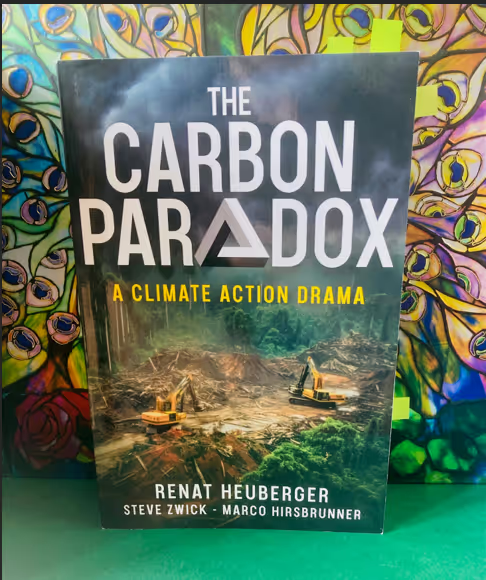
A Review of Renat Heuberger's, Steve Zwick's and Marco Hirsbrunner's "The Carbon Paradox"
Paradox (n.): A statement or situation that may be true but seems impossible or difficult to understand because it contains two opposite facts or characteristics. — Cambridge Dictionary
Coal miners in the 20th century used caged canaries to test air quality. The birds' high sensitivity to carbon monoxide and toxic gases made them early warning systems — if the canary stopped singing, the miners knew to get out.
The global economy in 2026 is that coal mine - literally. The canary stopped singing years ago. But we're still here, arguing about whether the environment is safe to work and live in.
The Carbon Paradox doesn't ask whether climate change is real. It asks a harder question: Why do the solutions we've built to address it keep creating new problems — and how do we fund real climate action in an imperfect world?
Renat Heuberger, Steve Zwick, and Marco Hirsbrunner have written a book that's neither another apocalyptic warning nor a naïve techno-optimist manifesto. It's a reckoning with the complexity we pretend doesn't exist — told through 25 paradoxes that hide in plain sight, embedded in a narrative ambitious enough to be called an eco-thriller.
The Bottom Line
Climate solutions don't fail because we lack technology or capital. They fail because we introduce new dilemmas. Carbon credits were designed to scale climate finance — they did. But scaling introduced leakage, additionality questions, and claims inflation. Perfection became the enemy of progress. Ideological purity paralyzed action.
This book doesn't solve those paradoxes. It names them. And in doing so, it does what few climate books manage: it makes the case for pragmatic imperfection over paralyzed idealism.
Why This Book Matters in 2026
The book was published in 2025. If it had come out five years earlier, it might have made the case for climate action inescapably even clearer to a broader audience.
2026 is a different world. Political headwinds against ESG. Regulatory rollback (EU Omnibus "simplification"). Decision Makers, Investors, Regulators and Boards deprioritizing sustainability altogether. Carbon markets under scrutiny for integrity failures.
In this context, The Carbon Paradox refuses to retreat into despair or denial.
It acknowledges the mess. The integrity scandals. The greenwashing. The gap between ambition and execution. But it also shows that taking action — imperfect, contested, paradox-laden — remains the only option. And impact scaling matters, because climate physics doesn't care about our political cycles or ideological purity tests.
Three Perspectives
Climate finance — and why we're still fighting about whether it’s a solution
The book opens with a viral video: a girl swept away by floodwaters. Three university students are galvanized into action.
What begins as idealism crashes into reality. Hard.
Take this real world example: Companies that emit greenhouse gases often do have the capital and operational leverage to decarbonize. But they're also criticized for buying offsets. So they face a choice: act imperfectly now, or wait for regulatory/reputational clarity — and delay transition. The same goes for ESG investors and (re)insurers – what’s better in the end divest from fossil fuels completely or engage with them and progress on set climate targets?
Heuberger and his co-authors don't defend greenwashing. They dissect it. But they also ask: If we wait for a perfect climate finance instrument, how many more floods happen while we design it?
25 paradoxes and why decision-makers, investors and boardrooms struggle to act
This book does something most climate literature doesn't: it spotlights complexity, addresses trade-offs in and translates macro-level climate economics into decision-making.
The book unpacks all 25 different paradoxes after each other, i.e.:
Each one adds an additional brush to the complete picture.
The book is full of these. And what makes them powerful isn't just that they're true — it's that they explain why so many well-intentioned climate strategies fail in execution. Boards, portfolio companies and investors don't struggle with climate action because they're indifferent. They struggle because every decision triggers a cascade of paradoxes that no one prepared them for.
Fiction vs reality
The genius of this book is its structure. It's a novel. Not a business book dressed up as a story — an actual narrative with characters, stakes, and emotional weight.
Canland (the representative for the global north) and Demba (global south) aren't real. But the Paradoxes are. The Pigou effect is. The Keeling Curve is. The governance failures that led to major environmental damages while we debate progress — those are real.
By turning real problems into a fictional world, the authors achieve something most scientific papers and traditional climate business books can't: they make the complexity digestible without dumbing it down.
You can sense that these paradoxes, although in narration, come from the background of an entrepreneur who had skin in the game navigating these complex issues at the frontlines.
The book covers ground that would overwhelm most readers if presented as scientific lesson or policy analysis: externalities (Arthur Pigou), baseline methodologies, leakage calculations, the difference between avoidance and removal credits, voluntary vs. compliance markets. But because it's embedded in a narrative where three students are trying (and failing, and trying again) to make carbon finance work for a real community, the learning curve feels playful rather than punishing.
For Whom This Book Matters
This book isn't for carbon market technical experts or sustainability regulation lawyers. It's not for those seeking ten-step blueprints or clean answers.
It's for decision makers who need to understand why climate strategies fail in execution — and what their choices mean thousands of kilometers away from boardrooms.
Specifically:


.avif)
.avif)