.avif)
Switzerland is stable. That message resonated throughout the Finance Forum Zurich 2025 – from government officials to bank CEOs. But stability without sharp ambition risks becoming complacency. My impression after a day of insights and debate: the next three years will decide whether the Swiss financial center remains a leader – or quietly slides into the comfort zone.
1) Market access remains the bottleneck. Without a predictable relationship to the EU, cross-border wealth management narrows. Proportional regulation and institution-specific approaches are not luxuries – they are location factors.
2) Private Markets are going retail – transparency is the entry ticket. Opening private markets to wealthy individuals can be powerful. But without robust product governance (fees, liquidity, reporting), reputational risk outweighs the benefit. BlackRock’s focus on tokenization points in the right direction – execution will decide.
3) Crypto is (finally) boring – and that’s why it matters. Bitcoin’s volatility has at times dropped below equities and even gold. With proper governance, digital assets can become a legitimate building block in multi-asset portfolios.
4) AI works – scaling doesn’t. 95% of firms still see no real ROI from AI investments. The reason: pilots never move to full deployment. Compliance and operations use cases show promise – but success requires end-to-end integration, clean data, and clear stop/scale criteria.
5) Leadership makes the difference. For me, the standout moment came from @Giorgio Pradelli (CEO, EFG International): clear on fundamentals, ambitious on future growth, delivered with charisma and conviction.
1) We confuse regulation with risk management. More rules ≠ less risk. True ownership must sit in the first line of defense, with regulators focusing on proportionality and outcomes, not box-ticking.
2) We talk about innovation but rarely buy it. Proof-of-concepts without a procurement pathway are innovation theater. Dual-track sourcing and fast-lane onboarding for start-ups are overdue.
3) We underestimate the next generation of wealth. Young clients demand digital-first advice, plain-language reporting, and exposure to tokenized assets. Ignoring this is not conservative – it’s shortsighted.
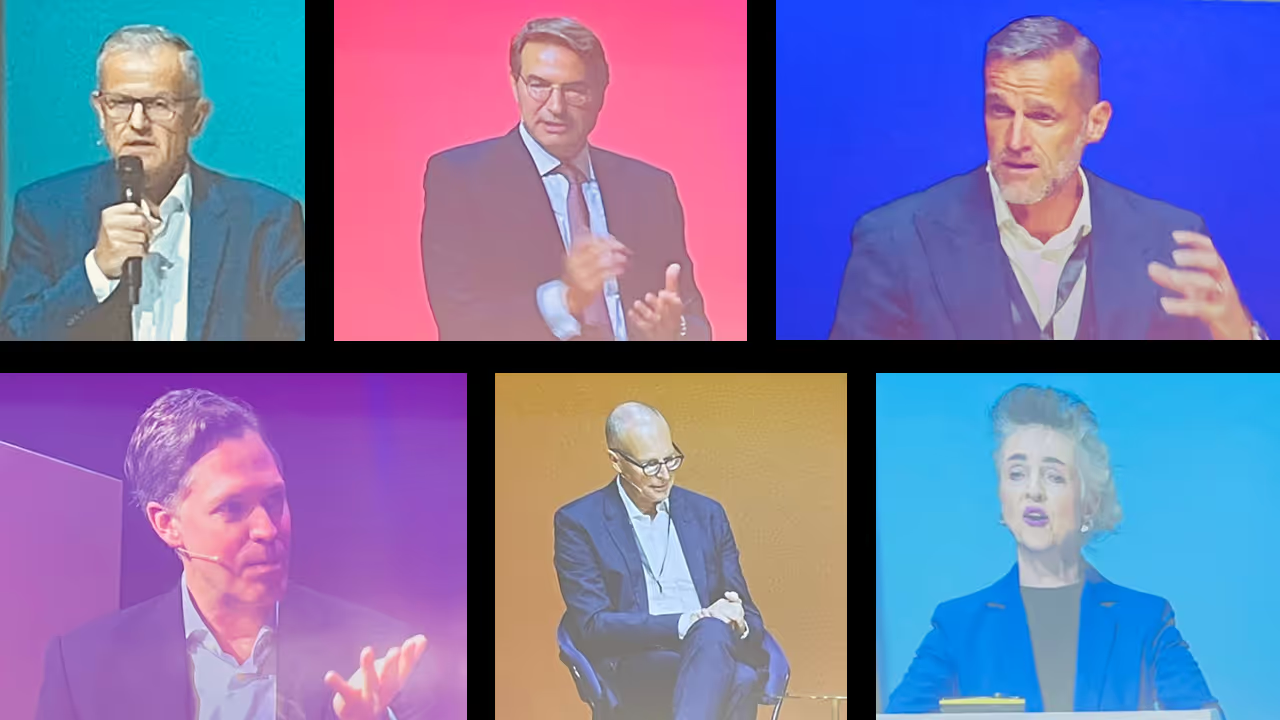
The Protagonists (TBR)
The Finance Forum Zurich 2025 confirmed: our fundamentals are world-class – but our ambition risks mid-class. The challenge is not to preserve stability, but to channel it into velocity.
Personally, I found the presence of Giorgio Pradelli most compelling: charisma, clarity, and conviction that made the case for a forward-looking Swiss finance.
Many thanks to CFA Society Switzerland for enabling participation, and to CFA Society Liechtenstein for their support. I look forward to a Finance Forum 2026 that delivers not just insights – but measurable outcomes.
🔹 This article also marks the launch of my new newsletter The Briefing Room (TBR) – where I’ll share concise, thought-provoking takes on finance, leadership, and innovation. If you found this valuable, I’d be delighted if you subscribe and join the conversation!
🔹Sidenote: Not another newsletter... The Briefing Room exists only if it adds value – and you, the readers, will decide if it does.


.avif)

.avif)